
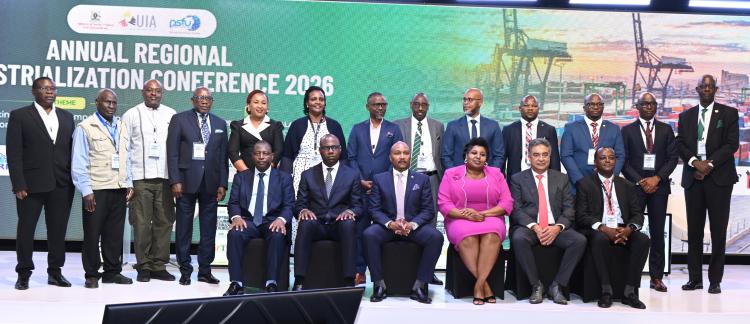
President Museveni Calls For Stronger Government-Private Sector Partnership To Drive Industrialization
President Yoweri Kaguta Museveni has called for stronger Government-private sector partnership to accelerate industrialization, deepen regional economic integration and position Uganda to take greater advantage of expanding markets in East Africa and across Africa.
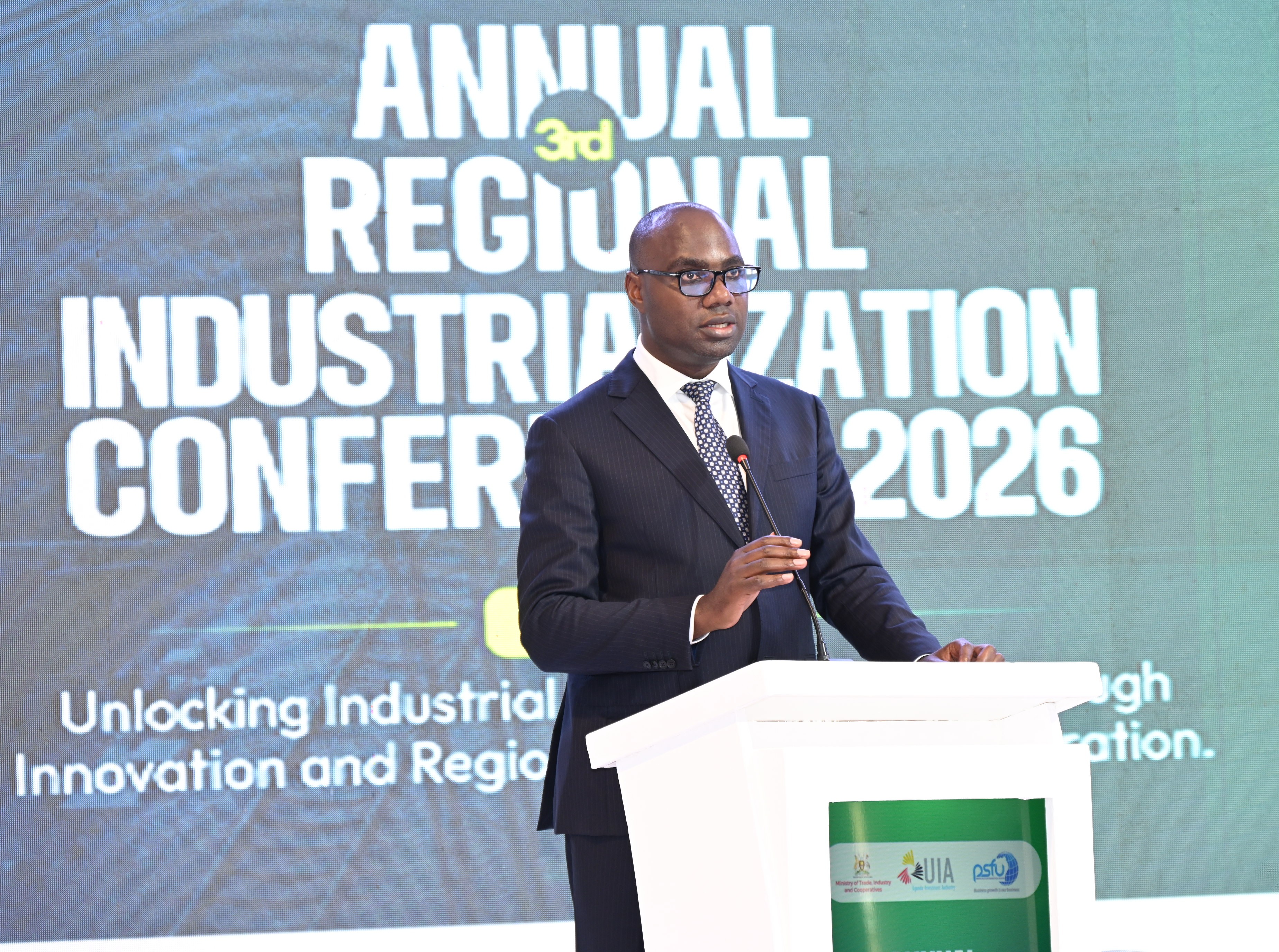
The President’s message was delivered by the Minister of Finance, Planning and Economic Development, Hon. Henry Musasizi, who represented him at the 3rd Annual Regional Industrialization Conference 2026, held on August 18–19 at Serena Hotel under the theme “Unlocking Industrial Competitiveness through Innovation and Regional Value Chain Integration.”
The conference brought together Government, private-sector leaders and other stakeholders to discuss practical measures for strengthening industrial competitiveness, expanding regional value chains and moving from policy commitments to increased production and trade.
Industrialization at the center of economic transformation
Addressing the conference, Hon. Musasizi said industrialization is central to Uganda’s economic transformation because of its potential to create jobs, add value to the country’s natural resources, expand intra-regional trade and reduce vulnerability to external economic shocks.
“Industrialization creates jobs, adds value to our abundant natural resources, expands intra-regional trade in manufactured goods, and reduces our vulnerability to external shocks,” he said.
He said Uganda’s industrialization strategy is anchored in the country’s national development framework, with the accelerated development of industrial parks providing an important foundation for manufacturing, agro-processing and other productive activities.
The Minister highlighted the Kampala Industrial and Business Park at Namanve, which covers approximately 1,000 hectares, as a major production hub attracting investment in manufacturing, logistics, food processing and agro-processing.
He also cited the Sino-Uganda Bio-Industrial Park, covering about 619 acres, which, according to the figures presented, hosts approximately 75 factories and employs more than 12,000 people. The Industrial Park at Kapeeka with 34 operational factories and direct employment of approximately 6,000 people was also highlighted.
Musasizi said Government is expanding the industrial footprint beyond existing parks, including development of a planned smart eco-industrial hub in Hoima covering approximately 29.57 square kilometres, alongside efforts to establish additional industrial parks in other parts of the country.
The industrial parks are intended to support production not only for Uganda’s domestic market but also for the wider East African and African markets. Among the priority value chains identified are agro-processing, leather, textiles, pharmaceuticals, petrochemicals, steel, construction materials and logistics.
East Africa presents a major market opportunity
Musasizi said Uganda’s industrialization agenda must be pursued within the context of regional and continental market opportunities.
He noted that East Africa has a consumer market of more than 400 million people, while the African Continental Free Trade Area provides access to a market of about 1.4 billion people.
He urged stakeholders to approach East Africa as a shared market rather than viewing economic opportunities only through individual national markets. “We should be looking at this as a region for all of us, not what is there for Uganda, what is in it for Kenya, what is in it for Tanzania, but what is in it for all of us as a regional market,” he said.
He reaffirmed Uganda’s commitment to the ideals of regional integration through the East African Community, including deepening economic integration under the Customs Union and Common Market frameworks, addressing non-tariff barriers, operationalizing one-stop border posts and expanding access to regional markets.
“East Africa's trade must grow further, and Uganda stands ready to play its full part in making the community a true engine for shared growth,” he said.
The Minister said stronger regional integration would provide manufacturers with a larger market in which to achieve economies of scale, while supporting regional value chains in areas where East African countries have comparative productive advantages.
Private sector central to the growth ambition
Musasizi said Uganda’s long-term growth ambition requires genuine partnership between Government and the private sector. The Ministry of Finance’s Tenfold Growth Strategy targets expansion of Uganda’s economy from about $50 billion to $500 billion by 2040, with private-sector investment and competitiveness playing a central role in achieving the transformation.
“Government remains fully committed to creating an enabling policy, regulatory, and investment climate that allows private enterprise to thrive,” Musasizi said.
He said Government would continue listening to the private sector, undertaking reforms where necessary and working with businesses to develop solutions that allow investment, innovation and job creation to take place at the scale required.
He said the private sector approach is consistent with the broader growth strategy, which seeks to strengthen Uganda’s competitiveness in tradable sectors, expand exports, attract investment, and increase value addition.
Region must produce, manufacture and export more
The Minister of State for Trade, Industry and Cooperatives (Industry), Hon. David Bahati, said East Africa must increase production, manufacturing and exports if the region is to become more competitive.
“We need to produce more, we need to manufacture more and we need to export more,” Bahati said. He said the region has significant productive resources and a large and growing market but must address constraints that continue to limit industrial competitiveness.
Bahati identified electricity, infrastructure, irrigation, regional connectivity and non-tariff barriers among the key issues requiring attention. On electricity, he said industrialization depends on reliable and affordable power and noted Uganda’s commitment to supporting manufacturers with lower-cost electricity while continuing to improve generation.
He also pointed to the importance of regional infrastructure and connectivity in reducing the cost and time of moving goods.
Bahati said East African countries should also address barriers that restrict the movement of goods within the region. He cited Uganda’s sugar production as an example, noting that Uganda has excess sugar production while some neighboring countries continue importing sugar from outside the region.
“How can we be producing sugar? We have excess sugar of 200,000 metric tons. Kenya is importing sugar from Brazil. How can that happen?” he asked.
He said resolving such challenges would strengthen intra-regional trade and enable East African countries to make greater use of productive capacity within the region.
Bahati also called for greater investment in irrigation and productive utilisation of the region’s land to increase food production and reduce reliance on imports.

Manufacturing remains a major employment and growth driver
The Private Sector Foundation Uganda (PSFU) Board Chairman Humphrey Nzeyi said manufacturing remains an indispensable engine for sustained economic growth and employment in East Africa.
He said manufacturing currently contributes an average of 9.7% to 11.8% of regional GDP, compared to the EAC industrialization policy target of 25% by 2032. In Uganda.
Nzeyi said manufacturing contributes more than 16.5% of GDP and supports approximately two million direct jobs, while also generating tax revenues and export earnings.
At the regional level, he said manufacturing absorbs roughly one-third of foreign direct investment. Nzeyi also noted that intra-EAC trade reached $14.3 billion in 2024, with manufactured goods accounting for 42% of that trade.
“These figures demonstrate both the progress that we have made and the vast untapped potential,” he said.
He said manufacturing has wider economic effects because expansion of the sector creates jobs along value chains, increases agricultural incomes through processing, reduces import dependence, strengthens foreign exchange earnings and supports structural transformation.
Private sector calls for practical regional solutions
Nzeyi said the conference was convened to bring together policymakers, industrialists, financiers and development partners to address practical barriers constraining regional competitiveness.
He identified high and short-term capital costs, residual non-tariff barriers, infrastructure and energy constraints, standards and recognition challenges, illicit trade and limited cross-border value chain linkages as key constraints.
He called for practical and time-bound interventions, including blended finance facilities with longer tenures, accelerated elimination of non-tariff barriers, mutual recognition of standards and authorised economic operators, harmonised incentives for multi-country industrial parks and special economic zones, and stronger regional enforcement against illicit trade.
“Government set the enabling environment, the private sector and factories create the jobs and integrate the value chains,” Nzeyi said.
He said stronger cooperation between Government and business, supported by predictable policies, coordinated infrastructure and deliberate incentives for regional sourcing, would be critical to positioning East Africa as a competitive industrial region.